As Egypt accelerates its ambitious urban development plans—most notably through the creation of New Cities and the revitalization of historic urban centers—the conversation around infrastructure has shifted. It is no longer just about building more; it is about building better. Within the framework of Egypt Vision 2030, Automated Parking Systems have emerged as a critical component in the transition toward sustainable, efficient, and technologically integrated urban living.
Aligning with Egypt Vision 2030 The national agenda for 2030 prioritizes sustainability, economic efficiency, and the improvement of the quality of life for all citizens. Traditional parking models, which rely on vast surface lots or massive, energy-intensive underground concrete structures, often conflict with these goals. They contribute to urban heat islands, increase soil impermeability, and require significant energy for lighting, ventilation, and security.
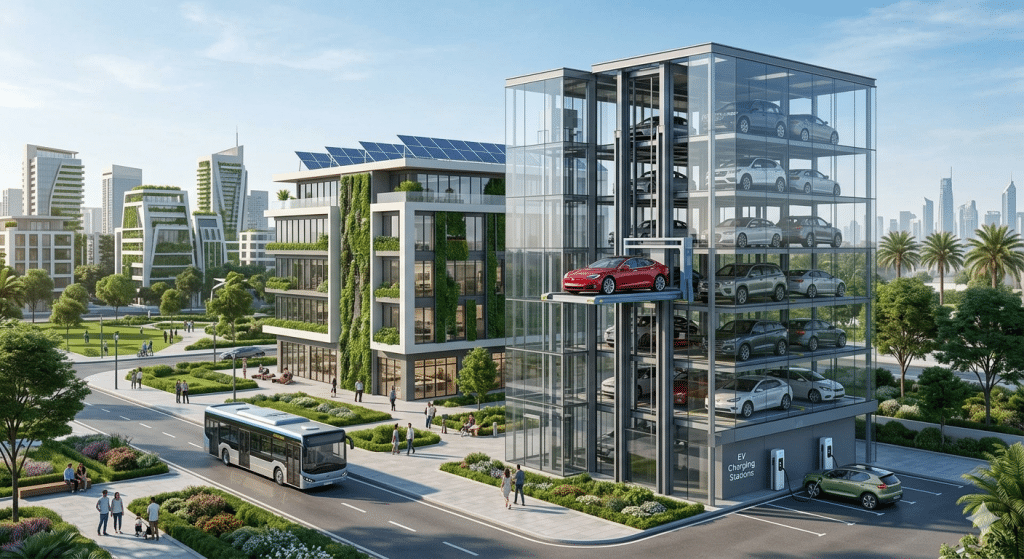
Automated parking systems, however, are inherently “lean.” By condensing the physical footprint of parking, they allow for more green spaces, pedestrian walkways, and public parks within urban developments. This alignment with sustainable land use is a direct contribution to the green transition that Egypt is striving to achieve.
Reducing Carbon Emissions through Smart Logistics One of the most significant, yet often overlooked, environmental impacts of traditional parking is the carbon footprint created by drivers searching for a space. Research suggests that a significant percentage of urban traffic congestion is caused by vehicles “cruising” for parking. Each minute spent idling or circling a block translates into unnecessary CO2 emissions, fuel wastage, and air pollution.
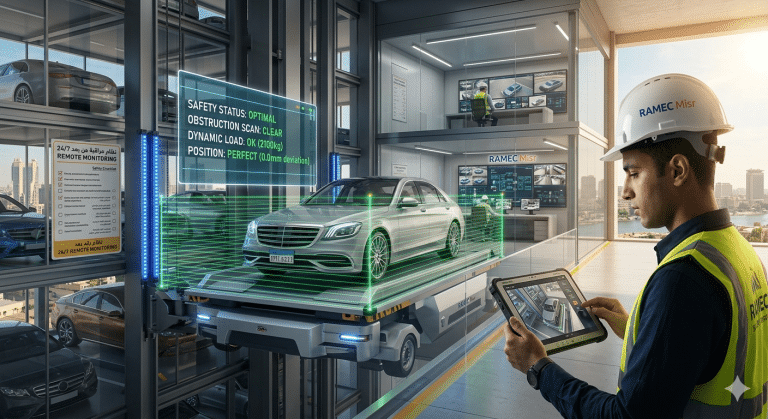
Automated parking systems eliminate this “cruising” phenomenon. Because the process is centralized and managed by software, the driver knows exactly where their car will be stored, and the system delivers it back to the ground floor with precision. By removing the need for vehicles to circulate within a garage, these systems significantly reduce the local exhaust emissions and noise pollution typically found in large parking facilities.
Energy Efficiency and Smart Grid Integration Modern automated parking systems are designed for high energy efficiency. Since the storage area is inaccessible to humans, there is no need for high-intensity lighting or climate control in the parking bays. Energy is only consumed during the active movement of the car. Furthermore, as Egypt embraces electric vehicle (EV) infrastructure, automated garages serve as the perfect hub for integrated charging stations. A centralized robotic system can manage vehicle movements to ensure that cars are charged during off-peak hours, contributing to a balanced and stable electrical grid.
Promoting Urban Densification without Congestion Sustainable urban planning emphasizes “densification”—the idea of creating compact, walkable cities rather than urban sprawl. However, high-density developments traditionally require enormous parking ratios that can kill the aesthetic and functional quality of a neighborhood. Automated parking allows developers to increase density while keeping the parking invisible. It ensures that ground-level real estate is reserved for human interaction, commercial activity, and green space, rather than rows of parked cars.
A Step Toward the Future For Egypt’s new administrative and commercial hubs, adopting automated parking is a statement of intent. It demonstrates that the development is not only modern in appearance but also advanced in its operational philosophy. It signals to investors and residents alike that this project respects the environment, optimizes resources, and values the precious time of its inhabitants.
In conclusion, the integration of automated parking into the Egyptian urban landscape is not merely a technical upgrade; it is an environmental imperative. By adopting these systems, we are choosing a path that balances the inevitable growth of our cities with the necessity of preserving our resources for future generations.