For any property owner or facility manager, the installation of an automated parking system is a long-term capital investment. While these systems are engineered for high performance, their ability to provide seamless service depends entirely on a robust maintenance strategy. Understanding the Maintenance of Smart Garages is not just about fixing issues as they arise; it is about proactive management that guarantees vehicle safety, minimizes downtime, and protects the longevity of the infrastructure.
Why Proactive Maintenance Matters Unlike traditional concrete parking lots, which require basic cleaning and structural inspections, smart garages are complex electro-mechanical machines. They involve PLC controllers, hydraulic systems, high-torque motors, and sensitive sensor arrays. A failure in one sensor could potentially halt the entire retrieval process. Therefore, maintenance must shift from “reactive” (fixing what is broken) to “preventive” (maintaining what is running). Regular, scheduled maintenance ensures that the system operates within its design parameters, preventing sudden mechanical fatigue and extending the lifespan of the machinery by decades.
The Pillars of a Reliable Maintenance Program A comprehensive maintenance protocol for smart garages rests on four primary pillars:
-
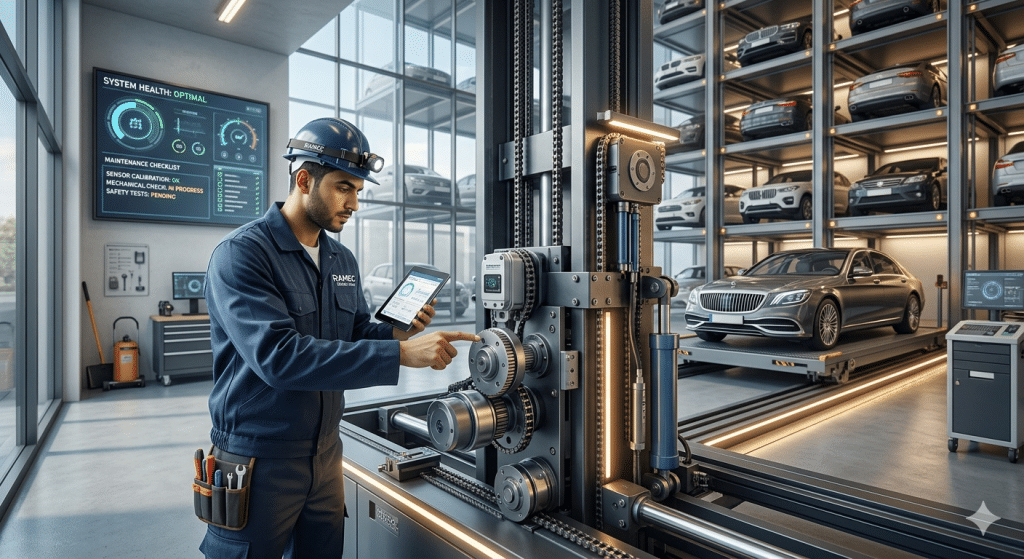
Sensor Calibration and Safety Testing: Automated systems rely on infrared and ultrasonic sensors to detect vehicle positioning. Regular calibration ensures these sensors are accurate, preventing any potential contact between the vehicle and the structure.
-
Mechanical and Hydraulic Inspection: Over time, heavy-duty chains, gears, and hydraulic cylinders experience stress. Periodic lubrication, tension checks, and leak inspections are critical to prevent premature wear and ensure smooth, quiet operation.
-
Software and Control System Updates: As the “brain” of the operation, the software must be updated to patch vulnerabilities and improve retrieval speed. Regular diagnostic checks can identify software glitches before they lead to operational delays.
-
Emergency Protocol Simulation: A crucial part of maintenance is the periodic testing of safety backups—such as manual override systems and fire suppression mechanisms. Ensuring these are functional gives users peace of mind and keeps the facility compliant with local safety regulations.
Enhancing User Experience Through Reliability For the end-user, “reliability” is synonymous with “speed and trust.” A system that breaks down is not just a nuisance; it erodes the reputation of the property. When maintenance is performed consistently, the system functions like clockwork. This reliability creates a “premium experience” for tenants and customers, fostering long-term loyalty and justifying the value of the property.
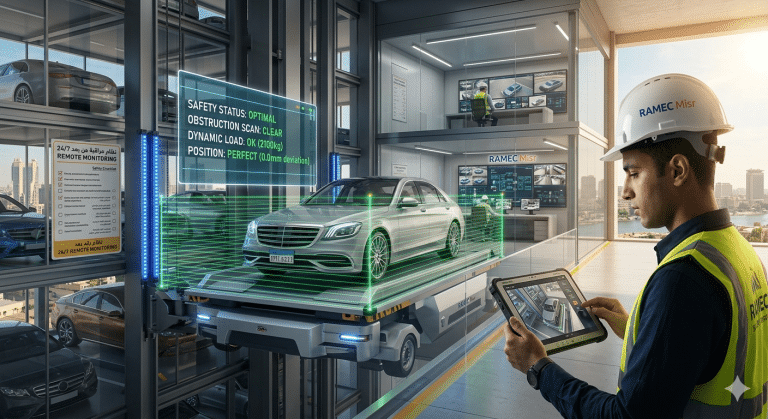
The Role of Professional Support In the Egyptian market, it is vital to partner with companies that offer specialized after-sales service and 24/7 technical support. An automated system is only as good as the team behind it. Owners should prioritize maintenance contracts that include remote monitoring—a feature that allows technicians to diagnose potential faults from afar, often fixing minor issues before the owner even realizes there was a problem.
Conclusion Maintenance is the ultimate safeguard for your investment. By prioritizing the upkeep of your smart garage, you are protecting not only the expensive machinery but also the vehicles of your clients and the operational efficiency of your property. Remember, a well-maintained smart garage is the hallmark of a world-class facility, demonstrating excellence in both technology and management.