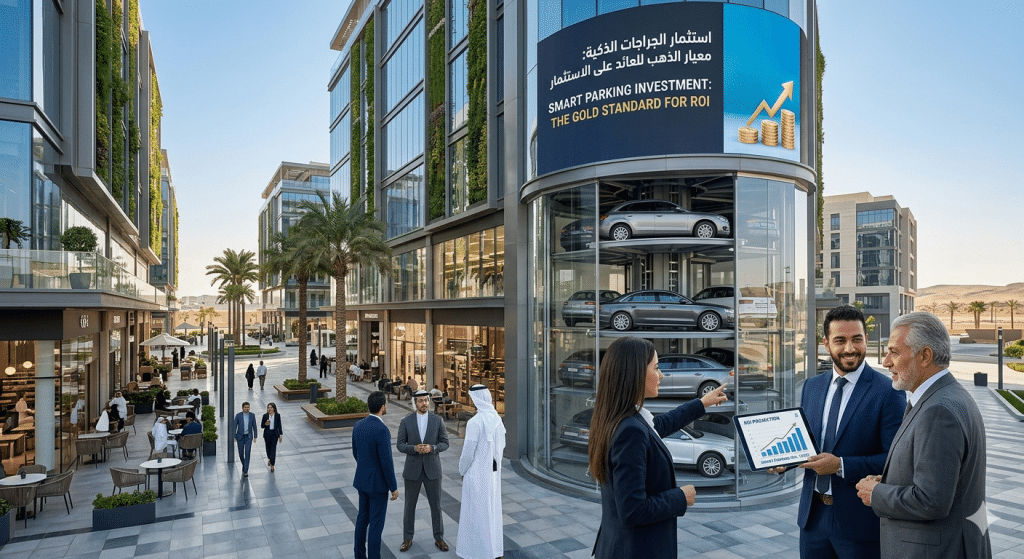
In the world of commercial real estate, profitability is driven by space utilization and customer experience. As land prices in Egypt’s major hubs continue to climb, traditional infrastructure costs are eroding potential margins. For the visionary investor, Parking Investment has shifted from a “necessary expense” to a strategic asset. By integrating smart, automated parking systems, developers are turning underutilized areas into high-performance profit generators.
Transforming a Cost Center into a Profit Center Historically, parking has been viewed as a mandatory “cost center”—a drain on capital that provides no direct revenue. However, with automated systems, the paradigm changes. When you reclaim the massive amount of space wasted on concrete ramps and driving aisles, you create extra leasable square footage. Imagine adding ten additional retail kiosks in a mall or extra premium storage units in an office tower. By condensing parking, the footprint saved directly translates into new, high-margin revenue streams that pay for the system itself over time.
The “Value-Add” Factor for Premium Tenants Commercial tenants—whether they are multinational corporations, high-end clinics, or luxury retailers—prioritize accessibility. A facility that offers an “automated, secure, and instant” parking experience is an immediate standout in the market. This unique value proposition allows property owners to command higher rental premiums and service charges. In a city where “finding a spot” is a source of daily stress, offering a frictionless parking solution becomes a powerful leasing incentive, reducing vacancy rates and ensuring long-term tenant retention.
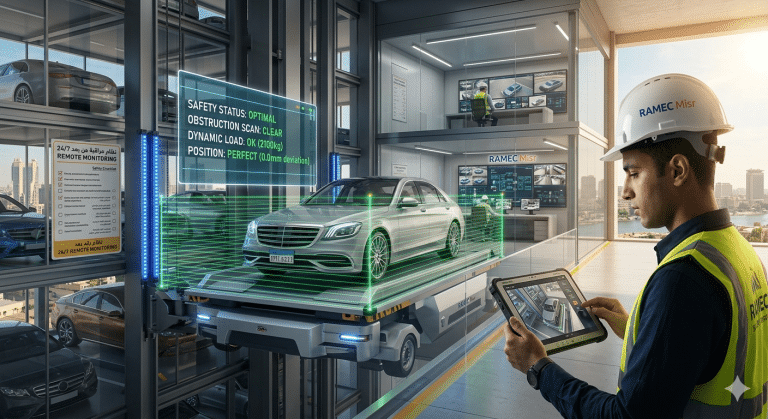
Reducing Long-Term Liability and OPEX Investors often focus on the upfront CAPEX (Capital Expenditure), but the real profit killer in real estate is high OPEX (Operating Expenditure). Traditional multi-level garages are expensive to staff, light, clean, and maintain. In contrast, smart garages are largely self-managing. They require fewer security guards, drastically reduced electricity for lighting, and zero ventilation requirements for the parking bays. This leaner operational model protects the bottom line, year after year, significantly increasing the net operating income (NOI) of the property.
Scalability and Marketability Smart parking systems are modular and scalable. An investor can start with a compact unit and expand it as the project grows or as demand increases. This flexibility is crucial in the volatile Egyptian market, where developers need to adapt to shifting urban requirements. Furthermore, when it comes time to sell or refinance the asset, a “Smart Building” certified property—featuring automated parking—carries a higher valuation than a traditional one. It is a future-proof asset that signals sophistication and modern efficiency to prospective buyers.
The Strategic Bottom Line For the commercial investor, the decision is simple: continue building the way it was done thirty years ago, or leverage current technology to create a superior product. Investing in smart parking is not just about the convenience of the car; it is about the efficiency of the land. It is about maximizing every square centimeter to ensure that your property delivers the highest possible financial return.