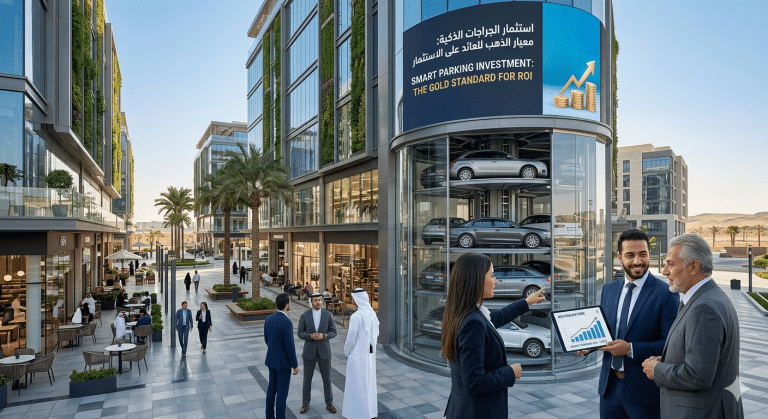
In the landscape of modern urban infrastructure, the word “parking” is undergoing a profound technological transformation. No longer confined to sprawling asphalt lots or multi-story concrete cubes, Parking Technology has evolved into a sophisticated field of electro-mechanical engineering. For developers, architects, and investors in Egypt, understanding the different classifications of automated parking systems offered by a market leader like RAMEC Misr is essential to selecting the right solution that balances spatial constraints, capacity requirements, and budgetary considerations.
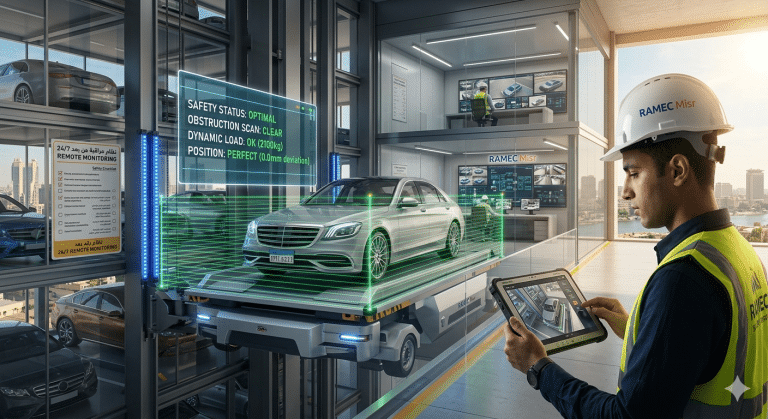
The Engineering Logic Behind Automation At its core, all automated parking technology shares a single goal: to maximize density by removing the human driver from the parking process. Without the need for driving lanes, turning radii, passenger doors opening, or pedestrian walkways within the storage area, cars can be packed with incredible efficiency. The engineering logic relies on a combination of sensory inputs (lasers, ultrasonics), control software (PLCs), and mechanical actuators (motors, hydraulics, chains) to manage the entire cycle from acceptance to retrieval.
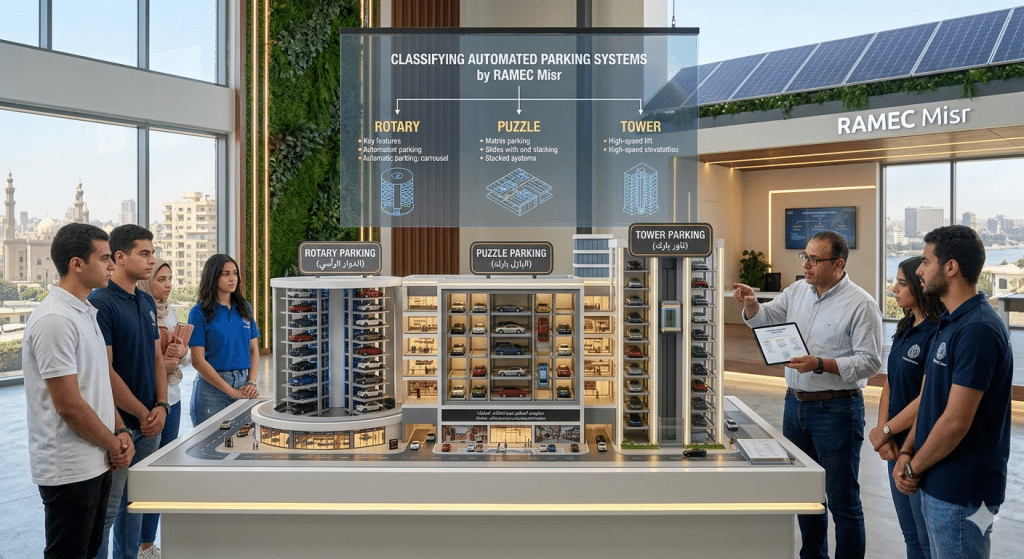
Classifying the RAMEC Misr Solution Portfolio RAMEC Misr specializes in three main categories of automated parking systems, each optimized for different structural and spatial requirements:
1. Rotary Parking Systems (The Vertical Carousel)
-
Engineering Logic: Think of a vertical Ferris wheel for cars. A continuous chain of pallets rotates vertically, bringing the desired car to ground level.
-
Best For: Small footprints, quick installation, and retrofitting existing properties. RAMEC Misr’s Rotary systems can typically stack 8 to 16 cars in the space of two surface spots. They are popular in dense Cairo neighborhoods like Zamalek or Heliopolis.
2. Puzzle Parking Systems (Sliding and Stacking)
-
Engineering Logic: A matrix of multi-level pallets where each car can move both horizontally (sliding) and vertically (stacking). A computer logic creates an empty space below the target car to lower it to the ground.
-
Best For: Medium-to-high capacity, especially in basements with restricted ceiling heights or surface areas with medium width. RAMEC Misr’s Puzzle systems offer high flexibility in design.
3. Tower Parking Systems (Elevator Style)
-
Engineering Logic: A centralized high-speed lift (elevator) that transports cars vertically between levels. At each level, a sliding mechanism transfers the car horizontally into a parking bay on either side of the shaft.
-
Best For: High-rise buildings where maximizing vertical space is the priority. These systems can go 20+ stories high, storing dozens of cars on a very compact plot of land. They are ideal for prime real estate in the New Administrative Capital.
Key Engineering Considerations for the Egyptian Market When deploying these technologies, RAMEC Misr prioritizes several engineering factors tailored to the local market:
-
Durability and Climate Resistance: Systems are built to withstand high ambient temperatures and dusty conditions.
-
Power Supply and Backups: Robust hydraulic systems are often favored for their reliability, but redundant power sources are critical for all automated solutions.
-
Safety Interlocks: Multi-layered safety sensor grids (detecting human motion, car positioning, and dynamic load) are non-negotiable in all RAMEC Misr products.
Conclusion The diversity in parking technology ensures that there is a solution for every spatial challenge. From the compact efficiency of a Rotary system to the high-rise capacity of a Tower system, the choice is driven by the specific operational needs of the property. By understanding these classifications, Egyptian stakeholders can make informed engineering decisions that optimize their real estate assets for the automated future, in partnership with a trusted local expert like RAMEC Misr.