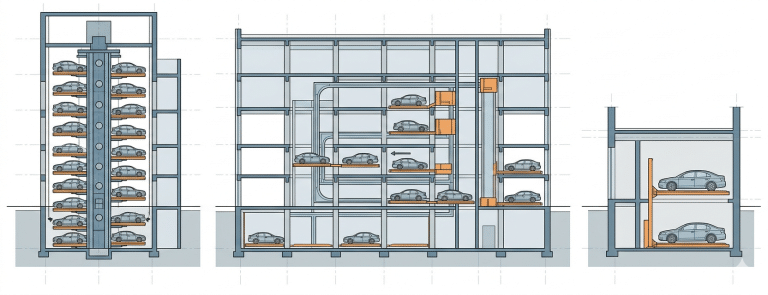
Modern real estate development focuses entirely on maximizing the efficiency of every square meter within residential and commercial projects. When planning vehicle parking layouts, consulting engineers and developers constantly face a critical design choice: expanding vertically downward via multiple concrete basements, or embracing modern technological solutions.
In this article, we provide a comprehensive engineering comparison highlighting the fundamental differences between designing traditional concrete basements and integrating a mechanical hydraulic parking lift system.
The Structural Comparison: Traditional Basements vs Mechanical Systems
Analyzing the structural and engineering impact on a building’s framework reveals radical differences across several key metrics:
1. Net Usable Footprint (Space Efficiency)
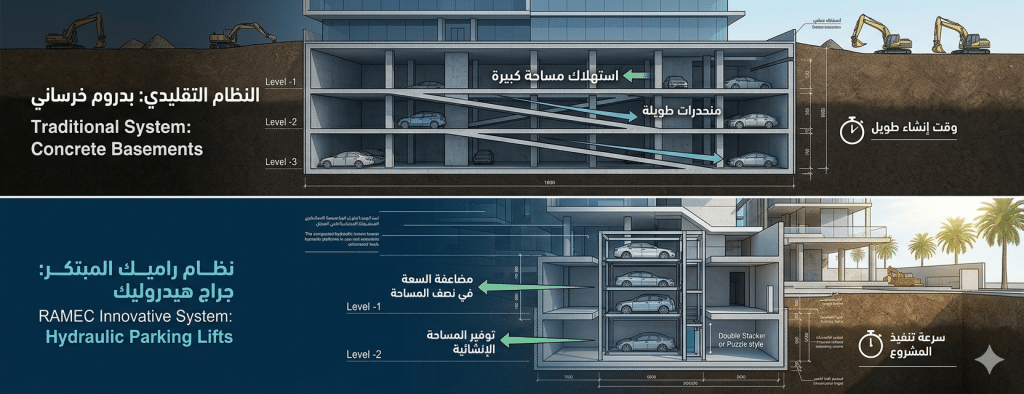
In concrete basements, driving ramps, retaining walls, and massive structural pillars consume a substantial footprint, drastically reducing the net parking efficiency. Conversely, installing a hydraulic parking lift eliminates these architectural obstacles entirely. By exploiting vertical height to stack multiple vehicles on a single surface plot, developers can effectively double their parking capacity compared to traditional layouts.
2. Construction Timeline
Excavating multiple subterranean levels demands a long construction timeline, involving extensive deep digging, shoring systems, and continuous groundwater dewatering. These complex civil processes can delay the entire project’s completion date. On the other hand, hydraulic and mechanical systems are assembled and installed during the final finishing phases within a few weeks, significantly accelerating the overall project delivery.
3. Safety and Civil Defense Compliance
Deep concrete parking garages require complex mechanical ventilation, continuous smoke extraction systems (Jet Fans), and extensive fire-fighting networks spanning vast zones. Meanwhile, a modern hydraulic parking lift features built-in, factory-certified safety mechanisms engineered to international standards. These systems seamlessly comply with civil defense regulations, simplifying the approval process for engineering blueprints.
Architectural Flexibility and Design Freedom
Embracing hydraulic lifts and smart parking configurations grants architects absolute freedom in optimizing above-ground spaces. Instead of being restricted by a dense grid of concrete pillars in the lower basements—which heavily dictates the structural layout of the entire building—mechanical systems offer an open, adaptable floor plan that complements premium commercial facades and entrances.
Ultimately, pioneering real estate development relies on adopting smart solutions that optimize engineering workflows, reduce delivery schedules, and provide end-users with a seamless, sustainable parking experience.