The efficiency of mega real estate developments, commercial towers, and administrative hubs relies heavily on precise infrastructure planning—particularly vehicle parking networks. As the industry accelerates toward mechanical alternatives, consulting engineers and architectural firms face the technical challenge of selecting the optimal configuration that aligns with a project’s structural limitations and physical footprint.
When auditing automated parking system manufacturers to secure the ideal engineering partner, it is critical to understand the primary mechanical typologies, their spatial requirements, and their architectural deployment.
1. The Rotary System: Tailored for Tight & Setback Spaces
The Rotary system is the premier choice for narrow land parcels, building setbacks, and compact urban infill sites:
-
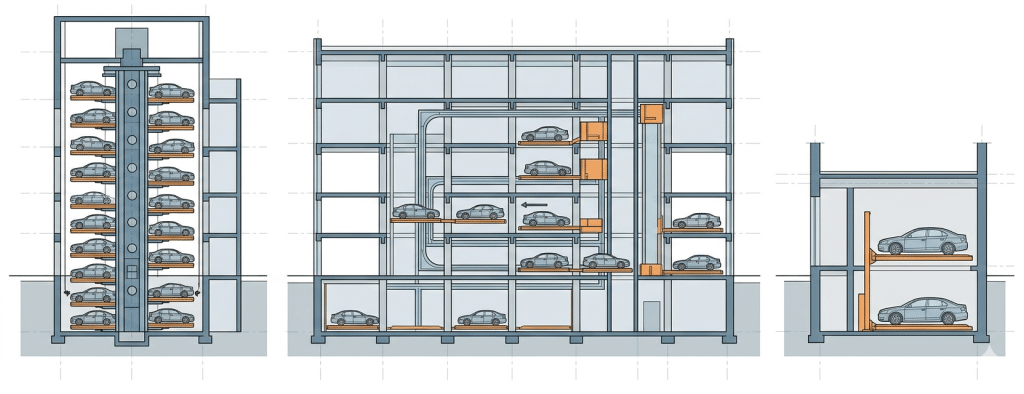
Operational Mechanism: It utilizes a vertical rotational mechanism (carousel style) to cycle and lift vehicles.
-
Architectural Fit: It occupies a minimal ground footprint—typically equivalent to just two traditional parking spaces—while expanding vertically to accommodate multiple vehicles.
-
Civil Requirements: Highly adaptable, it can be erected as a standalone steel superstructure above ground, avoiding deep excavation or complex concrete retaining works.
2. The Puzzle System: Engineered for Mid-to-Large Scale Developments
The semi-automated Puzzle configuration stands as the most versatile and widely implemented layout for commercial malls and corporate headquarters:
-
Operational Mechanism: Pallets move in a matrix configuration both horizontally and vertically, automatically creating an empty slot to retrieve or park any specific vehicle independently.
-
Architectural Fit: It offers highly scalable design profiles, ranging from two levels to multiple tiers, and can be integrated seamlessly within subterranean basements or as above-ground parking blocks.
-
Civil Requirements: It empowers structural engineers to maximize large contiguous floor plates, removing the need for conventional concrete driving lanes and turning radii.
3. The Double Stacker: Designed for Private Enclaves and Villas
The double stacker represents the most structurally straightforward mechanical solution, favored heavily in residential compounds, private estates, and corporate executive bays:
-
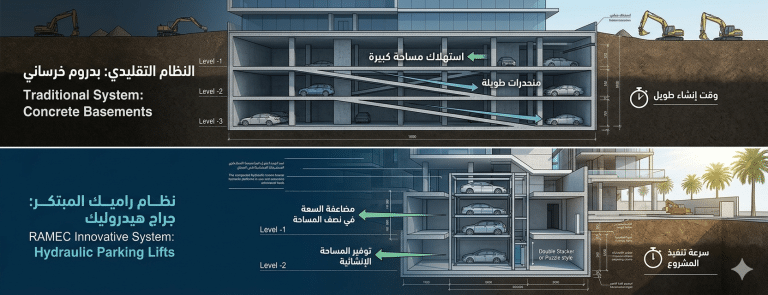
Operational Mechanism: A hydraulic lift raises one vehicle vertically, allowing a second car to be parked directly underneath (available in dependent or independent operational formats).
-
Architectural Fit: It requires a standard calculated ceiling clearance within basements or can be deployed in exterior courtyards and open-air driveways.
-
Civil Requirements: It demands minimal civil preparation and provides an immediate solution to double parking capacity within restricted residential envelopes.
4. Selecting the Right Engineering Partner for Your Project
When assessing automated parking system manufacturers, the evaluation must extend beyond hardware specifications. Success depends heavily on the manufacturer’s pre-engineering capabilities—specifically their expertise in delivering precise shop drawings, ensuring full system integration with local fire codes (Civil Defense), and providing localized, responsive technical teams capable of executing preventative maintenance to guarantee continuous operational uptime.