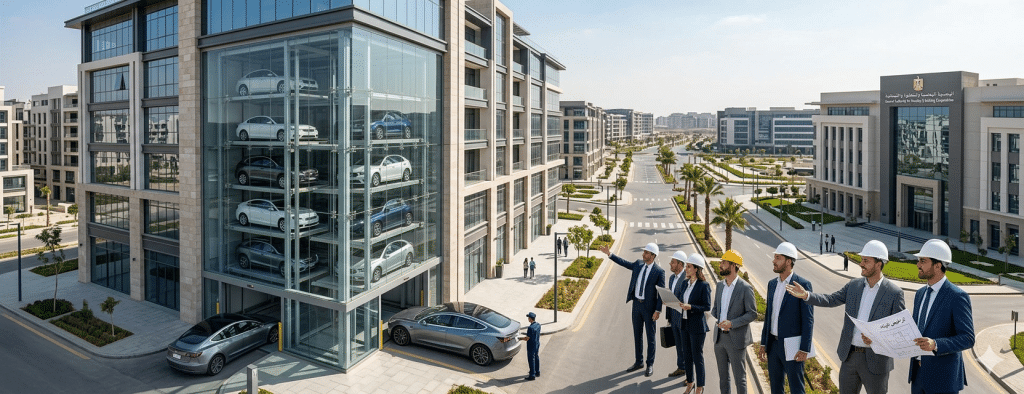
and commercial property owners in Egypt. With the enforcement of recent updates, providing adequate parking spaces is now a mandatory prerequisite for securing building licenses and operational permits.
This introduces a major space dilemma: traditional concrete parking lots consume massive footprints that could otherwise be utilized for premium residential or commercial units. In this guide, we explore how compliance with building law parking requirements can be seamlessly achieved using modern mechanical parking technology.
Understanding the New Building Law Parking Requirements
The Egyptian Building Code stipulates that every new structure must dedicate a calculated parking capacity based on the total built-up area and the building’s usage type (residential, administrative, or commercial). Failing to meet these specific quotas leads directly to:
-
Rejection of building permit applications by local municipalities.
-
Heavy legal penalties or immediate halts to construction activities.
-
Complications in securing utility connections upon project completion.
The core issue with traditional concrete designs is that structural columns, driving ramps, and turning lanes consume up to 40% of the net parking footprint. This makes full compliance nearly impossible on tight or urban land plots.
Smart Parking: The Legally Approved Engineering Solution
Utilizing mechanical and automated car parking systems is no longer a luxury—it is an approved engineering and legal solution recognized by official regulatory bodies in Egypt. These systems help developers easily fulfill building law parking requirements through several key advantages:
1. Multiplying Capacity on the Same Footprint
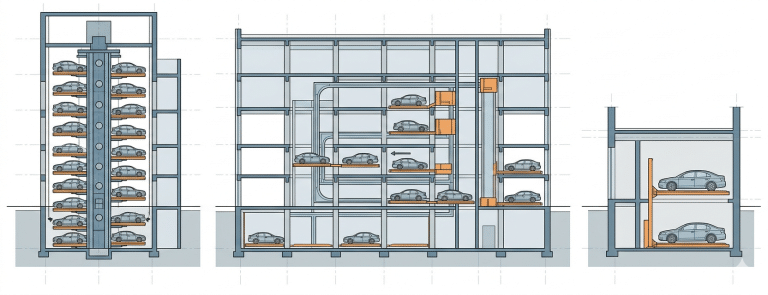
Mechanical systems (such as Puzzle or Double Stacker configurations) exploit vertical space, allowing two or three vehicles to be parked in a surface area traditionally reserved for a single car. This enables developers to meet the legally required parking capacity without digging multiple underground basements.
2. Civil Defense and Official Approvals
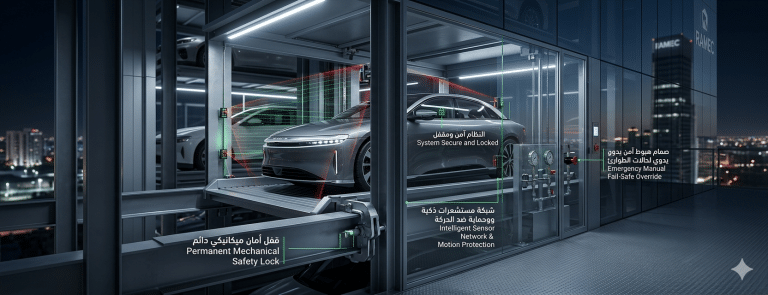
Advanced mechanical parking systems comply with international safety standards and hold official certifications from the Egyptian Civil Defense. This compliance is vital for certifying the parking infrastructure and securing the building’s final municipal license.
3. Structural Design Flexibility
By eliminating heavy concrete walls and excessive internal pillars, mechanical systems grant consulting engineers absolute freedom in building layout planning, optimizing upper floors for better commercial yield.
A Seamless Future for Real Estate Licensing
Integrating smart parking technology into the initial phases of architectural planning is the most strategic move for modern developments. It ensures that legal procedures progress smoothly, prevents regulatory violations, and delivers true value to the end-user seeking safety and convenience.